
affirming thoughts for creatives in an era of AI
why generative AI won't and shouldn't replace human creativity
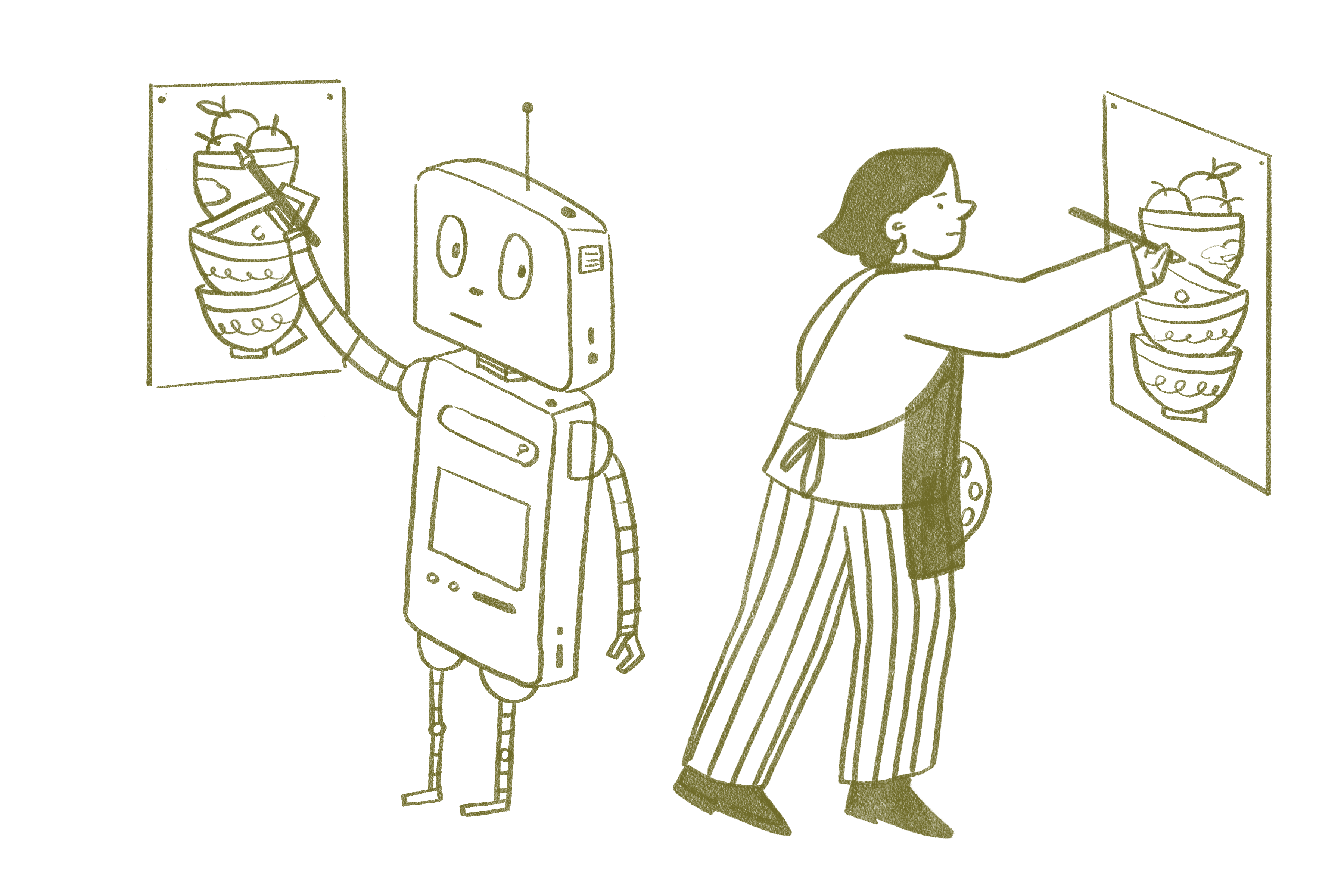
I know I’m not alone when I say it has been a bit discouraging to be a creative in this period of time. With the rapid integration of AI in all corners of society, and the rise of popularity with generative AI art trends, it has all felt too much and too fast.
Yes, AI is inevitable. As time and technology evolves, so will every industry needs to adapt and change with the times in some way. However, I think there are hard no’s and strong boundaries that we have to draw as creatives, or supporters of the creative world, especially when it comes to generative AI. As someone who relies solely on illustration to pay my bills, I’ve been quietly taking everything that’s been going on and have felt a mixture of rage and fear.
It’s only human of me, but of course I have occasional thoughts like will I be out of a job soon?, or is my job expendable?. Does illustration still hold value to potential clients? Do I lower my rates?? I could go on, but I’ve slowly been reflecting on some affirming thoughts for us creatives. P.S. the criticism I write about is directed at the billionaires and corporations that propel the use and integration of gen AI and who profit off of it.
Art is a reflection of the artist. The artist (or designer, crafter, maker etc) that created the piece put a part of themselves into it. Original art is original because it comes from the artist’s unique perspective and ideas.
Just like we can’t truly replace human touch or connection with a robot, we cannot replace the artist’s touch or artist’s hand with generative AI. Take this as an extra motivation to embrace imperfections and wonky details in your work. Focus on the ideation and process of making more than the outcome. Those artist touches are so valuable, so much so that AI is trying so hard, but failing, to truly replicate.
Even looking beyond artistic human touches, we need collaboration in the creative field! You, as a master of your craft and holder of niche knowledge and experiences, bring to the table what no AI model could.
“If we’re honest, our clients aren’t just buying ideas; they’re buying trust, partnership, and the confidence that someone truly gets their challenges.” — Tom May (Creative Boom, How creatives can double down on the skills AI will never replace, 2025)
Art is political. Always has been and always will be. How and by what means you decide to make or consume art matters. As you may already know, generative AI art directly profits billionaires by stealing artwork from real artists. I’ve been fortunate enough where I haven’t been knowingly stolen from yet, but from other artists’ experiences in my network, it sounds like an awful and hopeless situation. Possibly even more disturbing, is that generative AI propels the global climate crisis and freshwater scarcity.
“AI server cooling consumes significant water, with data centers using cooling towers and air mechanisms to dissipate heat, causing up to 9 liters of water to evaporate per kWh of energy used.” — Cindy Gordon (Forbes, AI Is Accelerating the Loss of Our Scarcest Natural Resource: Water, 2024)
We must be intentional with how we make and consume art.
Generative AI art is lazy, and keeps us from thinking critically about the world. It distances us completely from the intention and process of the art and its style. Artists take years and years to develop their original style and process. For companies to feed that style into AI machine learning is an atrocity. When something can be so easily replicated or mimicked, it loses its specialness. It loses its charm, and at no fault or control of the creative.
Take this as a sign to share your process more on your socials or explain your ideas and sketches from projects. I’m still learning how to do this more effectively, but I think it’s important for people to understand you and your unique thinking.
Creativity is much more exciting when not everything has to be perfect, and when it requires learning to master the skills. As a self-taught illustrator, I learned everything I know through research, networking, YouTube tutorials, and experimentation. When I was first learning, I would be up past midnight playing around on Adobe Illustrator, because my job at the time had an account I could use for free. I was so excited by the challenge and amazed at the capabilities of the program.
Unfortunately, the Adobe MAX conference this year proved to be super disappointing for the creative community for a number of reasons. The integration of AI into all its programs makes it feel like it’s leaving behind its original audience and first lovers of the programs. Instead of integrating new tools, Adobe’s neglecting the interests of working creative professionals. With the new “AI Assistant” roll out, they aim to provide “a faster way to create. Start with an idea, make sweeping edits to copy, color schemes and elements, animate and even resize — all in just a few prompts” (Adobe, 2025). Not everything that’s done faster, and more efficiently is better. Here’s a good recap of all the Adobe slop from Kelliot.
I understand that it makes these programs more accessible and palatable for people, however, it also creates an illusion that illustration, design, animation, video editing and audio mixing are not specialized, marketable skills anymore.
But any time I start worrying about this, I realize that AI art looks like slop because it IS slop. Anyone remember the Powell’s Books merch story? They hired an artist that used “AI-assisted tools” and after printing all the merch, people (not involved with Powell’s) called out the weird-looking book spines. Of course, it completely back-fired and Powell’s, the 53-year-old classic Portland bookstore, had to issue an official apology and statement for the use of AI.
Companies and clients have already started adding anti-AI clauses to contracts (as should you if you’re a working creative!), and I’m hopeful more and more will know where to draw the line. Don’t let generative AI discourage you from creating. Let your art be a resistance to these corporations and billionaires.
There are better and more sustainable ways to make art accessible. Art has historically had high barriers for people of lower income and BIPOC and/or LGBTQ2S+ communities to participate and engage in. However, I don’t believe gen AI is the solution. For example, making more community art grants available, funding art and design workshops for low-income folks, or providing art institution scholarships for historically marginalized groups.
So many of these AI companies like to cling on to the thought of ‘limitlessness’. and ‘seamlessness’. They love the notion that “anyone can do it” but I think it masks the whole point of art and creativity — that we get to learn, experiment and grow with the challenges and conditions the medium presents.
Human art allows us to learn about ourselves and how we like to express or see ourselves. It helps us connect with one another and build shared spaces and community. Art and human connection is something every single one of us needs in this world.
Anyways, if you made it to the end, thanks for listening and if you’re a fellow creative, hopefully this gave you a little bit more hope. Even though it’s been a slower year in terms of work, inquiries and commissions, I am even more appreciative of the clients who are coming to me and my fellow creatives for work. Thank you for seeing us, and trusting us with your visions. Ending off with the wise words of Van Gogh:
“I want to touch people with my art. I want them to say, ‘he feels deeply, he feels tenderly.” – Vincent Van Gogh
Signing off for now!
xx your human friend, Paige